Laser Fume Extraction for Industrial Laser Processes

Measure emissions. Optimize filtration technology. Reliably support processes.

Monitoring laser smoke, Fine Dust, and gaseous emissions directly at the source

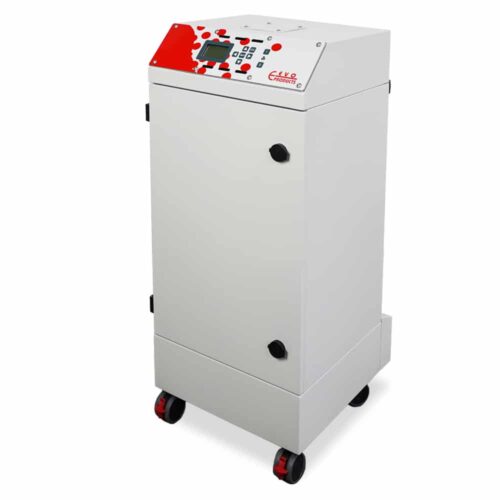
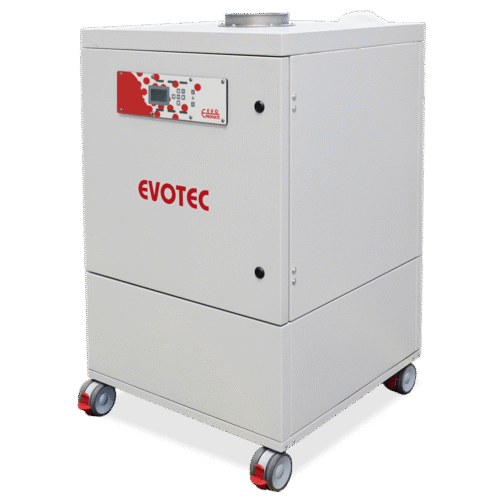
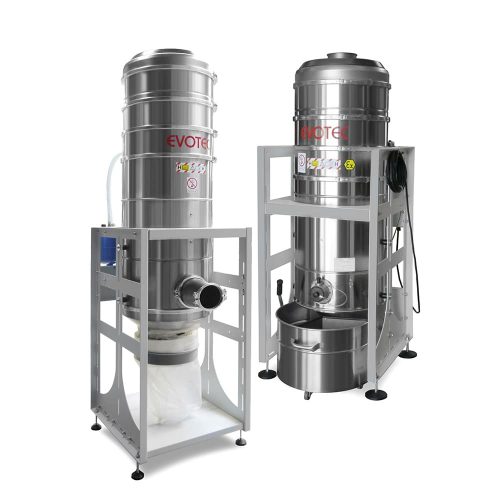
Depending on the material, laser cutting, welding, engraving, and cleaning generate fine particles and gaseous decomposition products. A suitable laser fume extraction system captures these emissions at the source and reduces their spread into the work area. EVOTEC tailors mobile and stationary extraction solutions to the material, the collection point, and the operating duration—with appropriate particle filtration and a separately evaluated concept for the gas phase.

The benefits of laser fume extraction:

Data Collection at the Source

Fume, aerosols, and particles are captured as close as possible to the source—to effectively reduce exposure in the work area.

Appropriate filter stages

Depending on the emissions, the system design combines appropriate particulate filters with supplementary stages for gaseous components.

Process-Oriented Design

Airflow, sensing element, filter area, and safety features are tailored to the material, laser power, and process.

Which exhaust system is right for your laser, material, and cycle time? Tell us about your process—we’ll work with you to review data collection, filter configuration, and integration.

What emissions are produced during laser processing?

Laser smoke is not a homogeneous substance. The base material, alloy, coating, and machining parameters are critical. Material data and available safety data sheets should therefore be considered at the very beginning of the design process.

Metals and Coated Surfaces

Laser welding produces particulate emissions whose composition depends on the material. For high-alloy materials, potential chromium and nickel compounds must be evaluated in particular. Coatings, oils, or residues must also be taken into account.

Further Reading: TRGS 528 – Welding Operations.

Plastics and Organic Coatings

Thermal decomposition can release various gases and vapors in addition to particles. For example, the DGUV lists formaldehyde for POM and styrene for polystyrene in the context of laser marking. This does not imply a general approval of a material for laser processing.

Source: DGUV Information 213-729.

Effective extraction helps protect health and limits deposits on optical components, machine surfaces, and workpieces. Any additional fire or explosion hazards must be assessed separately. Visible fume or odor alone are not reliable indicators of exposure levels.

How can laser smoke be effectively detected?

Capture determines effectiveness before the filter. An enclosure or partial enclosure limits the spread. In open processes, the intake opening must remain close to the work area and follow its movement. Even a high-quality filter cannot capture particles that never enter the exhaust system.

DGUV Information 203-093 describes these principles for open, hand-held, or hand-positioned laser equipment.

Machine, Enclosure, and Exhaust Table

Consider the exhaust connection, the airflow, and the machining area as a whole. When machining positions change, the extraction system must function effectively even at the most unfavorable point. An exhaust table requires an airflow pattern that is appropriate for the workpiece and the process.

Extraction arm and integrated detection

Position the opening so that emissions do not first pass through the breathing zone. Take into account clearance, cross-flows, and access to the workpiece. During handheld laser cleaning, on-the-fly detection is particularly important.

What type of filtration technology is required for laser fume extraction?

Particle filtration and gas treatment serve different purposes. The filter configuration must be appropriate for the emissions, dust load, and operating conditions; a list of as many filter stages as possible is not a guarantee of quality.

Particulate Filters and HEPA

Prefilters reduce the load on downstream fine filters. HEPA H13/H14 describes the classification of a particulate filter; a device’s dust class (M/H) should not be automatically derived from this. The specified device model and proof of intended use are decisive. H14 is not a blanket requirement for every laser process.

Cleaning and PreCoat

In cases of continuous dust accumulation, self-cleaning cartridge filters may be appropriate. Compressed air requirements, filter area, and waste disposal must be factored into the planning. For adhesive dusts, a tailored PreCoat design can protect the filter; however, it does not replace fabric testing or fire protection. The EP 2815/2822 series, for example, offers such options.

Gases, Vapors, and Activated Carbon

Particulate filters do not remove gaseous substances. Activated carbon is a potential additional filtration stage only for suitable substances and operating conditions. The loading and replacement procedures must be properly managed; a reduction in odor does not indicate sufficient removal of hazardous substances. An exhaust air system should therefore be evaluated at an early stage.

DGUV 203-093, Section: Exhaust Ventilation

Filter Replacement and Disposal

Maintenance access, monitoring of filter condition, and handling of the collected material are all factors to consider. Filters and collection containers must be replaced or emptied according to the properties of the material. Automatic cleaning does not replace regular inspection.

Exhaust system suitable for the laser process

Laser Cutting

The design is determined by the material, the cutting task, and the emission volume. For larger machining areas and multiple collection points, air distribution, the ductwork system, and filter load are critical.

Laser Welding

The welding process and the extraction system must be compatible. The base material and filler material must be taken into account in the assessment; the extraction system must not unduly interfere with the shielding gas flow. Learn more about welding and brazing fume extraction.

Laser Engraving and Laser Marking

Even compact workstations require an extraction system suitable for the material being processed. Include material changes, coatings, and emissions remaining in the process after an enclosure is opened in the process assessment.

Laser Cleaning and Stripping

In this context, it is particularly important to evaluate the removed layer, not just the substrate. For hand-held Class 4 applications, the DGUV FBHM-139 recommends detection close to the source, preferably integrated into the device itself. Laser safety remains a separate responsibility.

Laser-based additive manufacturing: The process chamber, powder handling, and cleaning each require appropriate solutions. We address these requirements separately under the topic of exhaust systems in additive manufacturing.

What information do we need for the design?

A flat-rate flow rate per laser power rating is not sufficient. The decisive factor is the required air volume at the sampling point, taking into account the actual pressure losses in hoses, piping, elbows, and filters. The maximum airflow rate specified by the manufacturer is not the same as the airflow rate in the connected system. Basis: DGUV Rule 109-002 – Workplace Ventilation.

Materials and Processes

  • Base material, alloy, coating, and known hazardous substances
  • Laser Process, Power, Processing Area, and Cycle Time
  • Dust volume, particle behavior, moisture content, and adherent components
  • A single workstation or multiple data entry stations active simultaneously

Installation and Operation

  • Sensing element, connection diameter, and cable routes
  • Required operating point based on flow rate and negative pressure
  • Shift work, compressed air, filter replacement, and waste disposal
  • Exhaust air or certified air recirculation, machine enable, and fault signal

Avoiding Common Mistakes: An extraction arm that is too far away, unplanned additional hose lengths, or a new coating that hasn’t been tested can render a previously suitable design ineffective. Changes to the process therefore call for a new evaluation.

Which data collection method is right for your workplace?

A sketch of the work area, information about the materials, and the planned duration of operation will be helpful during the initial consultation.

Safety: Evaluate exhaust air, fire protection, and EX separately

A filter class alone does not allow for air recirculation. Hazardous substances, effective monitoring, and applicable requirements must be evaluated together. Special rules apply to certain hazardous dusts, such as TRGS 560. Particle separation does not constitute proof of treatment of gaseous emissions.

When dealing with combustible dusts, material properties, potential ignition sources, and the entire system must be taken into account. ESD equipment does not replace EX certification. An ATEX option offered is only permitted within the specified application range; it does not constitute approval for every laser process. Learn more about the extraction of potentially explosive dusts.

The specific selection is based on the workplace hazard assessment and the manufacturer’s specifications. Exhaust ventilation does not replace protective measures against laser radiation.

Application Example:
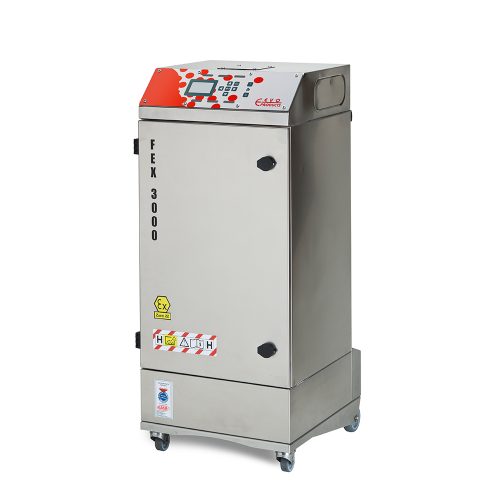
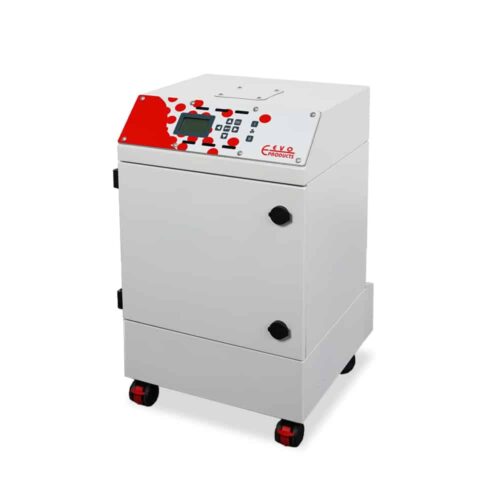
EVOTEC FEX 3000.1 for exhaust extraction during laser processing of technical metal components

Extraction of laser fumes and Fine Dust during the machining of housings, assemblies, and precision components.

Application Visualization – Partially AI-Generated

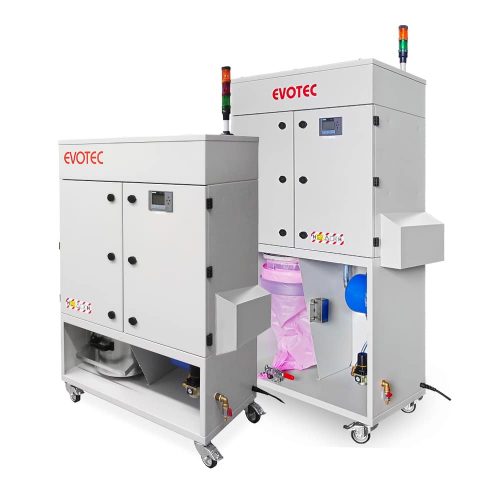
Stationary exhaust solutions for integrated laser processes

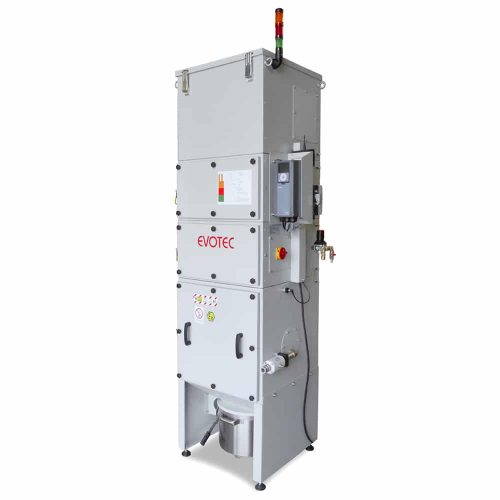
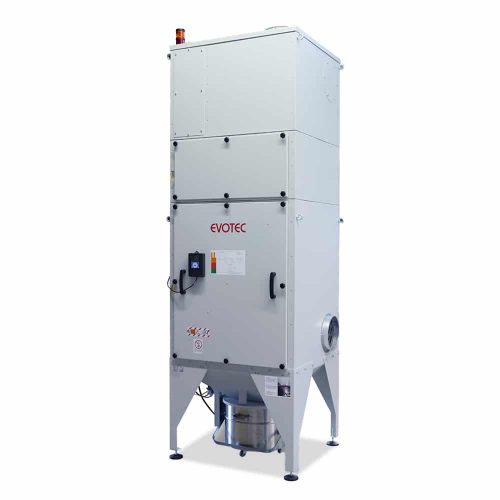
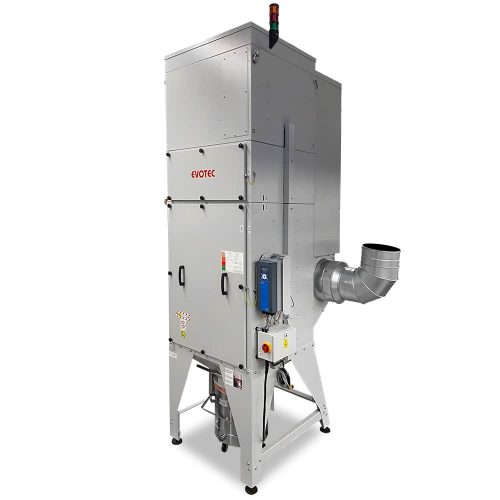
For permanently connected workstations and larger air volumes, customizable process exhaust systems are a viable option. The series shown here, which are categorized by application area, represent a preliminary selection—the specific filter and safety configurations must be compatible with the laser process. Compact systems can also be integrated directly next to the machine.

Frequently Asked Questions About Laser Fume Extraction (FAQ)

Does every laser system need an H14 filter?

No. The required filtration, equipment design, and airflow are determined by the substances involved and the risk assessment. H14 refers to a particulate filter and does not address either collection or gas treatment.

No. Smoke particles require suitable particle filters. An activated carbon stage may be an option for certain gaseous components, but it requires a substance-specific design and a reliable replacement plan.

This depends on the detection geometry, distance, the number of simultaneous extraction points, and line resistance. What is needed is the appropriate operating point in the connected system, not a figure derived solely from the laser power.

Only if the specific substances and applicable requirements permit it and the required effectiveness has been demonstrated. Therefore, exhaust air and potential air recirculation are explicitly evaluated during the design phase.

New alloys, plastics, or coatings may produce different emissions. Before use, the exhaust system, filters, airflow, and safety plan must be readjusted to accommodate the changed application.

EVO-PRODUCTS

Ihr Partner für industrielle Absauglösungen

EVOTEC develops extraction systems and industrial vacuum cleaners for industrial applications and produces not only production-ready units but also custom solutions tailored to specific applications. Our systems are designed for process reliability, durability, and individual requirements.

Years of experience
1 +
Developed models
1 +
Satisfied customers
1 +
MADE IN GERMANY
1 %
1
Analysis of the Situation
Abstimmungsgespräch zur Ermittlung kundenspezifischer Anforderungen
2
Concept Development
Gemeinsame Entwicklung von Lösungsansätzen sowie Ausarbeitung eines Absaugkonzepts unter Berücksichtigung der bestehenden Infrastruktur
3
Quotation Preparation
Detaillierte Angebotserstellung auf Basis der spezifischen Kundenanforderungen
4
Placing an Order
Abschließende Projektplanung und vertragliche Fixierung
5
Production
Maßgeschneiderte Fertigung der Anlagen und Komponenten
6
Delivery, Installation, &
Commissioning
Sichere Auslieferung der Anlage, Montage durch EVO-PRODUCTS-Techniker oder detaillierte Aufbauanleitung für kundenseitige Ausführung
7
Training, After-Sales &
Maintenance
Anlagen-spezifische Schulung, optionale Wartungsverträge & Services

Which laser fume extraction system is right for your process?

Please provide us with information on the material and coating, the laser process, the operating time, and the planned data collection. EVOTEC will assist you in selecting the appropriate filtration technology, airflow capacity, and machine integration.

Robin-graust..jpg

Robin Buschbaum
Sales D/A/CH
Specialist for extraction technology
vertrieb@evo-products.de
02642 9373-53

asim-03.jpg

Asim Zaman-Pahlke
Export Sales
export@evo-products.de
02642/9373-15

Scroll to Top