


Extraction Systems in Additive Manufacturing and Industrial 3D Printing
Home page » Additive Manufacturing
Extraction technology throughout the entire additive manufacturing process chain
Additive manufacturing processes generate a wide variety of contaminants depending on the process: metal or polymer powders during loading, unloading, depowdering, and sieving; ultrafine particles and volatile substances in filament-based processes; and dust during post-processing. A suitable extraction solution must therefore take into account the process, material, and process step collectively.
EVOTEC tailors mobile inert safety vacuum cleaners, collection components, and application-specific systems to the type of powder, dust volume, operating mode, and safety requirements.
The benefits of exhaust systems in additive manufacturing:
In-Process Powder Measurement
Powders and dust are collected as close as possible to where they are released—at the unpacking station, in the work area, at the screen, or at the post-processing station.
Safety Design Suited to the Material
Filters, separation, grounding, containers, and disposal are selected based on the specific properties of the powder and the materials.
Clean Cleaning and Powder Circulation Systems
Appropriate systems support controlled machine cleaning, reduce carryover, and help ensure that powder changes are organized in a traceable manner.
Which process, material, and work steps should be documented? Tell us about your machine, powder, and process—we’ll work with you to review the collection, separation, and safety design.
What emissions are generated during additive manufacturing?
“3D printing” is not a single, uniform process. Powders, filaments, and liquid resins pose different hazards. The level of exposure also varies depending on whether the process is enclosed, as well as during material handling, unpacking, cleaning, and post-processing.
Metal Powders in PBF, LPBF, and SLM
Very fine metal powders may be released during filling, unpacking, powder removal, sifting, and cleaning. Depending on the alloy, respiratory exposure, sensitizing or carcinogenic components, as well as fire and explosion hazards, must be assessed. Powders made of aluminum, magnesium, or titanium can be particularly reactive.
Polymer Powders, Filaments, and Resin Processing
Polymer powder-bed processes release fine plastic dust during material handling. Depending on the material and temperature, FFF/FDM can generate ultrafine particles and volatile organic compounds. In resin-based processes, vapors and skin contact are additional concerns; dust extraction alone does not fully address these hazards.
Measurements and protective measures must be tailored to the specific process. Technical guidance is provided by the BAuA report on powder-bed processes and the DGUV/IFA information on 3D printing.
At which process steps must materials be collected and cleaned?
Critical moments often occur outside the actual, closed construction process. When opening, transferring, or cleaning, powders can become airborne or be carried away. Therefore, containment measures, work procedures, and personal protective equipment must be planned as a coordinated approach.
Filling, Unpacking, Dust Removal, and Screening
Open powder handling should be contained as much as possible or captured directly at the point of release. Enclosed transfer systems, vented glove boxes, or suitable capture devices limit the spread. For CMR substances, particularly stringent requirements apply to enclosed or effectively vented work procedures.
Installation Space, Machine, and Work Environment
Residual powder on the construction platform, machinery, tools, and floors must be collected using equipment specifically designed for this purpose. Dry sweeping and blowing with compressed air will simply redistribute the Fine Dust. For blasting, grinding, or cutting operations performed after the construction process, it is also necessary to capture the dust generated during these processes at the source.
Which filtration and separation technology is right for you?
The correct solution is determined based on the risk assessment and material data. Dust class, separation principle, and disposal methods should not be selected based solely on particle size or a general product description.
Dust Class Based on Risk Assessment
Whether dust class M or H is required depends on the ingredients, evaluation criteria, and the device’s intended use. If the device contains nickel, cobalt, or chromium components, particularly strict exposure control may be necessary. The decisive factor is the demonstrated suitability of the entire device.
Inert or wet separation—material-tested only
Liquid-bound or inerted systems may be used for certain reactive metal powders. However, the medium and the equipment design must be specifically suited to the powder. Water is not a one-size-fits-all solution: light metal dusts can react with water to form hydrogen.
ESD, Grounding, and Explosion Protection as an Integrated Concept
Conductive hoses, equipotential bonding, and dissipative components limit electrostatic charging but do not replace certified EX suitability. Equipment category, zone classification, ignition source prevention, and the safe handling of the material being collected must all be considered together.
Low-Dust Disposal and Powder Replacement
Containers, bag systems, or liquid systems should allow for controlled discharge. Mixing of different powders must be avoided if the possibility of a reaction cannot be ruled out with certainty. Maintenance, filter replacement, and disposal must therefore be factored into the design from the outset.
Technical Classification: DGUV Information 209-084 “Industrial Vacuum Cleaners and Dust Collectors.”
Extraction Concepts by Process and Application
Metal Powder Bed Process
In LPBF/SLM processes, material recovery and safe containment are often conflicting objectives. Filling, unpacking, screening, and machine cleaning require defined interfaces. For reactive powders, specially approved inert or wet separation systems may be considered.
Polymer Powder Bed Process
Fine polymer powders may be released during unpacking, screening, and cleaning and may be flammable, depending on the material. Enclosures, local exhaust ventilation, appropriate filters, and low-dust recirculation or disposal are tailored to the specific powder and process volume.
FFF/FDM and filament-based processes
The focus here is on ultrafine particles and volatile substances. An enclosure with effective source extraction and appropriate exhaust air ducting can limit emissions. The filtration of particles and the handling of gaseous substances must be evaluated separately.
Resin Processing and Post-Processing
When working with liquid photopolymers, skin protection, adequate ventilation, and the proper handling of cleaning chemicals are essential. Grinding, blasting, or cutting cured components also generates dust, which should be captured directly at the post-processing workstation.
Important: The same machine may require a different protective solution depending on the material, powder condition, and production step. A change in the system or the introduction of a new material therefore warrants a reevaluation.
What factors determine the design of the exhaust system?
The right device is determined by the actual operating point and the specific process chain. In addition to airflow and negative pressure, other factors to consider include hose runs, interfaces, dust volume, simultaneous extraction points, and the intended operating duration.
Material and Powder Properties
- Metal, polymer, composite, or cured resin
- Alloy, safety data, and potential CMR components
- Particle size, flammability, explosiveness, and reactivity
- Permitted separation medium, powder replacement, and disposal method
Process, Interfaces, and Operations
- Filling, Unpacking, Removing Powder, Screening, Cleaning, or Post-Processing
- open or closed transfer, as well as existing machine connections
- Hose lengths, simultaneous suction points, and required operating point
- intermittent cleaning or regular shift work
Avoid common mistakes: A standard workshop vacuum cleaner, untested liquids, mixing of materials, or a lack of grounding can increase an existing risk. The equipment, accessories, and work instructions must be approved for the specific substance.
Which solution is right for your additive manufacturing process?
Information on methods, materials, powder condition, process steps, quantities, and operating time enables a reliable preliminary selection.
Do Not Treat Reactive Metal Powders with a One-Size-Fits-All Approach
Aluminum, magnesium, titanium, and other metal powders require a material-specific evaluation. Flammability, explosion characteristics, potential CMR components, and reactions with liquids vary significantly. In particular, contact between certain light-metal dusts and water can produce hydrogen. Inert or wet systems may therefore only be operated with the medium approved by the manufacturer and for the specific powder. Different powders must not be collected together without a compatibility test.
More on zone classification and equipment selection: Explosion protection for the extraction of explosive dusts.
Application example:
EVOTEC ECODustPro 15 WB for the controlled collection and passivation of reactive dust and cleaning after the 3D printing process.
A properly configured Inert industrial vacuum cleaner collects powder residue from the work area, the unpacking station, and adjacent work surfaces in a controlled manner and supports safe, material-appropriate cleaning of the work area.
Application Visualization – Partially AI-Generated
Inert Safety Suction Systems for Metal Powders in Additive Manufacturing
The inert safety suction units shown here, which are categorized by application area, represent a technical preselection for the controlled collection of suitable metal powders. Actual suitability depends on the specific powder, the approved liquid or inert medium, the zone, the process, and the disposal method.
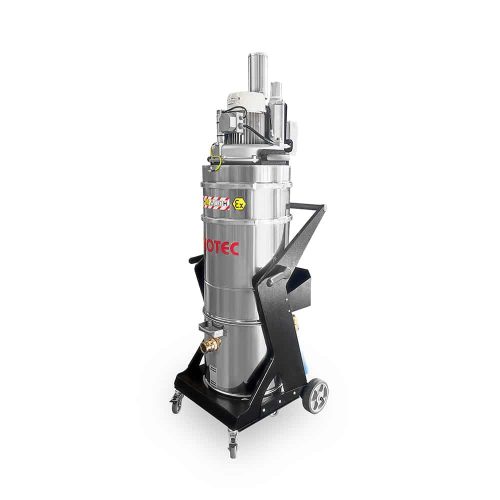
ECODustPro 15 WB “H/Model 22-EX”
Powerful inert safety vacuum cleaner with water bath and dirt container with integrated liquid bath separator for the safe extraction and passivation of reactive and potentially explosive dusts.
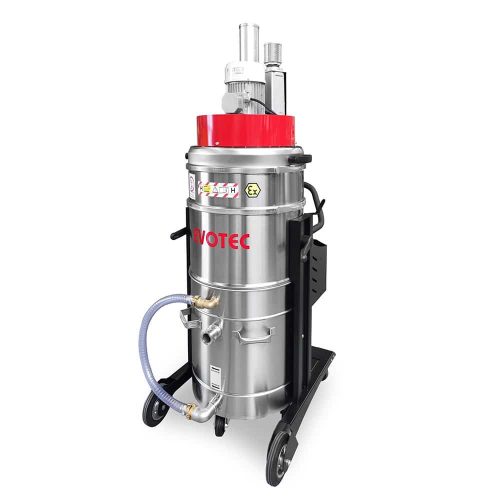
EP 2130 ECO-WB “H/Bauart22-EX”
High-performance inert safety vacuum cleaner with water bath and extra-large dirt container with integrated liquid bath separator for the safe extraction and passivation of reactive and potentially explosive dusts.
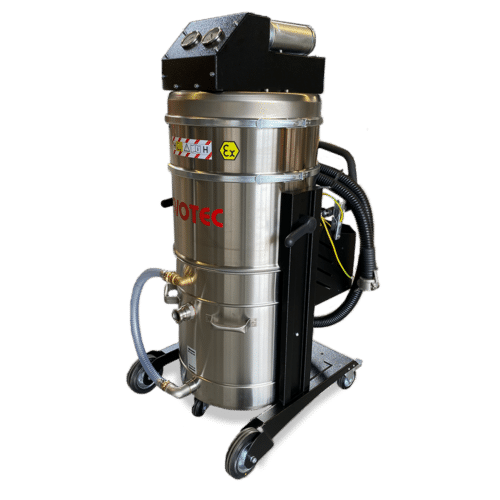
EP 312-100-WB “H/EX Zones 1, 2, 21, 22”
High-performance, compressed-air-powered inert safety vacuum cleaner with a water bath and an extra-large debris container featuring an integrated liquid bath separator for the safe extraction and passivation of reactive and potentially explosive dusts.
Frequently Asked Questions About Exhaust Systems in Additive Manufacturing (FAQ)
Which industrial vacuum cleaner is suitable for metal powder from 3D printing?
Only equipment that has been expressly approved for the specific powder and its intended use. Factors to be evaluated include, among others, alloy, reactivity, explosion characteristics, dust class, zone, separation principle, container, and disposal. The term “metal powder” alone is not sufficient for selection purposes.
Is a water bath always suitable for aluminum, magnesium, or titanium powder?
No. Certain light metal dusts can react with water to form hydrogen. The manufacturer must approve the fluid, additives, fill level, monitoring system, and equipment design for the specific powder. Inerting or other methods are also application-specific.
When is dust class M or H required?
This is determined by the risk assessment and the properties of the substance. For components that pose a particularly high health risk, dust class H may be required; for other tasks, class M may be sufficient. The decisive factor is the documented suitability of the entire vacuum cleaner, not just the filter designation.
Is exhaust ventilation also required for FFF/FDM?
Depending on the filament and printing temperature, ultrafine particles and volatile organic compounds may be produced. Effective containment with source extraction may be advisable. Particle filtration and the treatment of gaseous emissions must be considered separately.
Which process steps are particularly critical?
Of particular relevance are open-container filling, unpacking, powder discharge, screening, powder changes, and machine cleaning. In addition, there are dust-generating post-processing steps such as grinding, blasting, or cutting. The enclosed construction process is therefore only one part of the overall exposure assessment.
Your partner for industrial extraction solutions
EVOTEC develops industrial vacuum cleaners and extraction systems for industrial applications and produces not only production-ready units but also application-specific custom solutions. For additive manufacturing processes, materials, interfaces, and safety requirements are considered holistically.
Commissioning
Maintenance
Which extraction solution is right for your additive manufacturing process?
Please provide us with details regarding the process, machine, material or powder, process steps, quantities, operating time, and safety requirements. EVOTEC will assist you in selecting a system that is suitable for your specific material and process.

Robin Buschbaum
Sales D/A/CH
Specialist for extraction technology
vertrieb@evo-products.de
02642 9373-53

Lars Blankenburg
Sales
lars.blankenburg@evo-products.de
02642 9373-10

Asim Zaman-Pahlke
Export Sales
export@evo-products.de
02642/9373-15