


Extracting Compressible Fabrics – Stationary and Mobile Compression Solutions
Home page » Compressible fabrics
Safely handle and compact bulky, lightweight materials
Compressible fabrics and residual materials often have a low bulk density: fibers, threads, nonwoven fabric scraps, and paper or packaging scraps take up a lot of collection space, even though their mass is relatively low. Depending on their shape, they can also form bridges, block hoses, or place an unnecessary load on filter surfaces.
EVOTEC combines material-specific collection and conveying with a compacting collection system. This allows bulky materials to be collected continuously at the machine or on a mobile basis at various locations.
Your benefits when extracting compressible materials:
Material-Specific Data Collection
Fibers, threads, and edge strips are collected according to their shape, size, and location.
More usable storage capacity
Compaction in the collection system reduces the bulk volume and extends the replacement intervals.
Stationary or mobile
There is a suitable solution for both continuous machine integration and flexible cleaning.
Which compression solution is best suited for the material and process? Tell us the material type, dimensions, quantity per shift, source, conveyor route, and operating hours—we’ll work with you to evaluate the handling, transport, filtration, and collection processes.
Which materials can be vacuumed using compression?
“Compressible” is not a separate class of dust or hazardous substance. This term describes the ability to compact loose, voluminous material being extracted within the collection system. Whether the material is hazardous to health, flammable, or explosive must be assessed on a substance-by-substance basis, regardless of this capability.
Textile fibers, threads, and nonwoven fabric scraps
Spinning, weaving, cutting, and garment manufacturing processes can generate loose fibers, threads, lint, and scraps. Long or elastic materials place different demands on hose diameters, elbows, and collection systems than fine, free-flowing dust does.
Paper, cardboard, and packaging scraps
Cutting dust, edge trimmings, label scraps, and small pieces of paper or film quickly fill conventional containers. Material thickness, moisture content, electrostatic charge, and any sharp-edged components can affect safe conveyance and collection.
Other lightweight production waste materials may also be compressible in principle. A practical test using actual material is crucial: the particle or fiber shape, elasticity, moisture content, and contaminants determine whether the material can be reliably conveyed and compacted.
Why do bulky materials require a suitable collection system?
Loose volume is often the limiting factor. A large container may already appear full even though it contains only a small amount of material. At the same time, compaction and discharge must not interfere with airflow, filters, or workplace safety.
Make Better Use of Storage Capacity
If suitable material is compacted in the filter bag or compression container, more material can be collected between two changes. The degree of compaction that can be achieved depends on the material, moisture content, fiber length, and operating mode, and cannot be specified in general terms.
Prevent Bridge Formation and Blockages
Fibers, threads, and strips can become snagged at narrow points, sharp bends, or unsuitable inlets. Short conveying distances, appropriate cross-sections, and aerodynamic bends reduce this risk; the actual material flow remains the basis for the design.
Properly Design Collection, Transport, and Filtration Systems
The solution is viewed as a complete system. The collection element, airflow rate, negative pressure, hose or ducting route, filter, and collection system must be appropriate for the material and the actual operating conditions.
Record it directly at the source
On cutting, winding, conveying, or packaging machines, the material should be collected as close as possible to its point of origin or discharge. TRGS 500 identifies collection at the source as a fundamental dust control measure.
Match the hose and piping to the material being sucked up
Cross-section, length, bends, branches, and elevation differences affect the flow. For long fibers or larger sections, diameters that are too small and tight radii can lead to buildup. The required operating point is therefore determined based on the connected system.
Select a compression bag or collection container
The filter bag, compression container, and discharge system must be suited to the shape and quantity of the material. The replacement procedure, the weight of the filled container, and a dust-free removal process—as much as possible—should be taken into account during the planning phase.
Select filters and cleaning methods based on the material
Particle size, fiber structure, material properties, and the desired airflow determine the choice of filter material and equipment design. A high filter class is not automatically required for every compressible material; the key factors are the risk assessment and the suitability of the entire unit for its intended use.
The IFA overview of dust classes for industrial vacuum cleaners and dust collectors provides guidance on equipment suitability.
Stationary and Mobile Deployment Concepts
Continuous extraction at production machines
For continuously generated fibers, cutting scraps, or edge strips, a stationary, integrated extraction unit can continuously handle the material flow. At the same time, active collection points, cycle time, the piping network, and machine control are considered together.
Mobile Cleaning and Routine Cleaning Services
A mobile compression vacuum cleaner is ideal for changing machines, cleaning tasks, and intermittent material flow. It can be driven directly to the work site and collects the material in a compacting filter bag.
Textile and Nonwoven Processing
Fibers, threads, and lint can be generated continuously or in batches. The collection system must be aligned with the direction of material flow and must not interfere with the production process. For more industry information, see “Exhaust Systems in Textile Processing.”
Paper and Packaging Processes
Edge strips, trim scraps, and lightweight packaging components require stable conveyance without unnecessary bottlenecks. When handling varying sizes, the pickup and conveying path should be designed to accommodate the most challenging relevant material size.
Related Application: For material flows and processes in packaging manufacturing, see the section on extraction systems in the packaging industry.
What information do we need for the design?
A reliable selection requires actual material and process data. Simply referring to them as “fiber dust” or “paper scraps” is not sufficient, because their shape, quantity, and flow behavior can vary greatly.
Materials and Processes
- Material Type, Composition, and Available Safety Data
- Particle size, fiber or strand length, elasticity, and moisture content
- Volume per hour or shift, as well as continuous or intermittent generation
- Location of the defect, machine opening, and desired detection geometry
Conveyor Path and Collection
- Hose or pipe diameter, length, bends, and elevation differences
- One or more data collection points active at the same time
- Desired compaction level, bag or container changes, and disposal method
- Shift operation, filter cleaning, control system, and required safety design
Avoid common mistakes: Pipe cross-sections that are too small, tight bends, unknown material mixtures, or an underestimated proportion of fine particles can impair flow, filter service life, and safety. A material sample or a field test can help improve the initial selection.
Which compression solution is right for your material flow?
Photos or a sketch of the application site, a material sample, and information on quantity, conveying distance, and operating time enable a reliable preliminary selection.
Assess health, fire, and explosion hazards based on the material
Compressibility says nothing about how hazardous a dust is. Composition, particle size, moisture content, and potential contaminants determine the health and safety requirements. Dust clouds should be avoided, and deposits should be removed using appropriate vacuuming methods rather than by blowing them away.
Organic dusts and fibers—such as those from paper or textiles—may be combustible depending on the material and particle size and, under certain conditions, may form explosive dust-air mixtures. Whether an EX-rated design is required is determined based on material data, operating conditions, ignition sources, and zone classification; a blanket classification is not technically permissible.
Technical Basis: DGUV Information 209-084 – Industrial Vacuum Cleaners and Dust Collectors, TRGS 720 – Hazardous Explosive Mixtures, and GESTIS-STAUB-EX.
Stationary extraction system for continuous fiber and waste streams
For permanent machine integration, EVOTEC offers the EBG built-in vacuum cleaner with various turbine and hopper options. It is suitable for continuous dry dust and residue streams; a compression hopper version is available as a configurable option. The specific design is based on the material, air flow rate, piping system, and operating time.
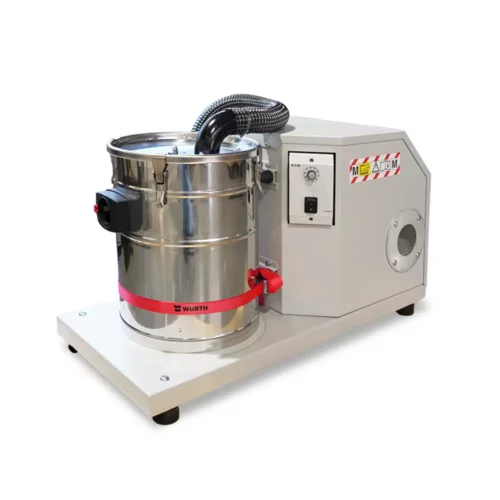
EBG built-in vacuum cleaner
- EC motor for continuous operation (24/7) and EX protection
- Process-adaptable extraction unit with high negative pressure for the extraction of all dry dusts
- Simple under-sink appliance with intelligent features
- Stainless steel version on request
Mobile compression vacuum cleaners for flexible collection and cleaning
The EVOTEC EP 2330/40 mobile vacuum compactor collects fibers, threads, and light paper and packaging waste, and compacts suitable materials in the filter bag. It is designed for use at various work sites, for cleaning machinery, and for handling intermittent material flow.
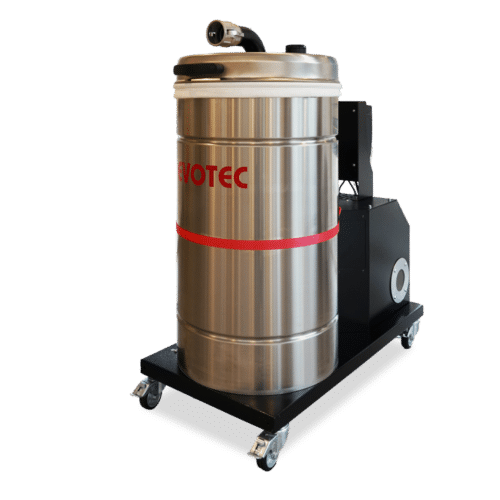
Compression vacuum cleaner EP 2330/ 40
Powerful compression vacuum cleaner with high pick-up volume and negative pressure for the effective pick-up and disposal of compressible materials.
Frequently Asked Questions About the Extraction of Compressible Fabrics (FAQ)
What are compressible fabrics and residual materials?
These include lightweight, bulky materials that can be compacted in the collection system—such as fibers, threads, nonwoven fabric scraps, paper and cardboard scraps, or suitable packaging scraps. Actual suitability depends on shape, moisture content, material composition, and conveying behavior.
How does a compression vacuum cleaner work?
The material being extracted is conveyed by the airflow into a filter bag or compression container, where it is compacted. This allows for better utilization of the available collection volume. The degree of compaction that can be achieved depends on the material.
When is a stationary solution appropriate, and when is a mobile solution appropriate?
A stationary solution is suitable for a continuous flow of material and for permanent integration with production machinery. Mobile vacuum compressors offer greater flexibility for changing work locations, cleaning, and intermittent use.
Can textile fibers or paper dust be explosive?
Yes, depending on their composition, particle size, and operating conditions, organic dusts and fibers may be flammable or form explosive mixtures. The risk assessment must take into account actual substance data, ignition sources, and a possible zoning classification.
What dust class is required for compressible fabrics?
There is no single dust class that applies to all compressible materials. The design of the equipment and filters depends on the material properties, exposure risk, intended use, and risk assessment. An H or EX design is not automatically required.
Your partner for industrial extraction solutions
EVOTEC develops extraction systems and industrial vacuum cleaners for industrial applications and realizes application-specific special solutions in addition to near-series devices. Our systems are designed for process reliability, durability and individual requirements.
Commissioning
Maintenance
Which compression solution is best suited for the material and process?
Please provide us with the material type, dimensions, quantity, collection location, transport route, operating duration, and desired pickup schedule. EVOTEC will assist you in selecting a stationary or mobile compaction solution.

Robin Buschbaum
Sales D/A/CH
Specialist for extraction technology
vertrieb@evo-products.de
02642 9373-53

Lars Blankenburg
Sales
lars.blankenburg@evo-products.de
02642 9373-10

Asim Zaman-Pahlke
Export Sales
export@evo-products.de
02642/9373-15