

Extracting Emulsions and Oily Liquids – Stationary and Mobile Solutions
Home page » Oily liquids
Safely collect and discharge oils, cooling lubricants, and emulsions
During metalworking, cooling lubricants, emulsions, oils, and swarf accumulate in machines, containers, and collection trays. For cleaning, media changes, and recovery, liquids and solids must be collected in a controlled manner, separated, and disposed of appropriately.
To this end, EVOTEC combines high-performance wet and swarf/emulsion extractors with a design tailored to the medium, viscosity, temperature, solids content, and discharge route. It is important to clearly distinguish between the collection of liquids and the extraction of airborne cooling lubricant aerosols.
Your benefits with emulsion and oil extraction:
Control the collection of liquids and swarf
Cooling lubricants, oils, and solids are collected directly from the machine, trough, or container.
Separate Media and Dispense Them Efficiently
Separation and emptying facilitate recycling, recycling, or proper disposal.
Design suited to the medium
Materials, hose systems, containers, and discharge systems are selected to suit the medium and operating conditions.
Which solution is best suited for the medium, the machine, and the discharge path? Tell us the type of coolant or oil, viscosity, temperature, chip content, volume, lift height, and operating time—and we’ll work with you to evaluate the intake, separation, and discharge processes.
What types of media and residues are produced?
“Oily liquid” is not a uniform fluid. Water-mixed cooling lubricants, pure machining oils, hydraulic oils, and contaminated cleaning fluids differ in viscosity, temperature, foaming properties, additives, and material compatibility. These specifications determine the selection of equipment and accessories.
Water-Mixed Cooling Lubricants and Emulsions
Emulsions contain water, oil, and additives in concentrations that vary depending on the process. When handling them, consider foaming, corrosion, pH, temperature, and the compatibility of containers, seals, and hoses. TRGS 611 is particularly relevant for the operational assessment of water-miscible cooling lubricants.
Oils that are immiscible with water and oil-containing media
Depending on the type, machining, cutting, or hydraulic oils can have significantly higher viscosities and different flash points. This affects suction capacity, discharge, and fire safety. The key factors are the safety data sheet, manufacturer approvals, and the actual operating temperature—not just the term “oil.”
Swarf, grinding particles, and foreign matter further affect the flow behavior. The solids content, particle size, sharp-edged components, and desired media recovery must therefore be recorded, just as the volume of liquid itself must be measured.
Where are emulsions and oils extracted?
Controlled intake prevents carryover and unplanned mixing. The vacuum cleaner is designed for the specific cleaning or emptying task at hand: from the machine sump to larger cooling lubricant tanks.
Cleaning CNC, Lathe, and Milling Machines
When cleaning the interiors of machines, liquids and swarf often accumulate together. A swarf/emulsion vacuum cleaner can collect both types of material and—depending on the model—separate them within the unit. This facilitates the recycling of usable fluids and reduces the need for manual cleaning.
Empty tanks, vats, and catch basins
When changing media or performing maintenance, tanks must be emptied quickly and in a controlled manner. The tank volume, suction distance, level difference, and subsequent discharge determine whether a drain, pump, or pressure-relief system is appropriate. Not every device is approved for all types of continuous pumping operations.
Properly Designing Separation, Filtration, and Discharge Systems
The suction system doesn’t end at the suction hose. Separation, level monitoring, and discharge must be coordinated so that the liquid can be handled safely and the solids content can be removed in a controlled manner.
Collect swarf and liquid separately
An integrated chip basket or a suitable pre-separator retains coarse solids. The appropriate mesh size depends on the shape and particle size of the chips. Fine particles may require additional filtration stages if the medium is to be recirculated back into the process.
Monitor the fill level and prevent overfilling
Wet vacuums require a reliable fill-level limit. When handling foaming liquids, it is also important to note that foam can affect the effective tank capacity and the automatic shut-off function. Operation and maintenance should be performed in accordance with the unit’s instruction manual.
Draining, Pumping, or Depressurizing
The appropriate discharge method depends on viscosity, solids content, discharge head, destination container, and desired cycle time. Pump or pressure discharge can speed up the discharge of the material; however, this requires a machine design intended for this purpose and a suitable, safe connection.
Oil-resistant hoses and suitable materials
Hoses, gaskets, couplings, and containers must be resistant to the specific medium, its additives, and the operating temperature. Sharp-edged swarf further increases the mechanical stress. The safety data sheet and manufacturer’s approval are decisive.
The design takes into account the medium, temperature, viscosity, pH, additives, and solids content. A general approval “for oil and emulsion” does not replace this evaluation.
Distinguishing Between Liquid Extraction and Coolant Aerosol Extraction
Remove any liquids from the machine and container
Portable wet and swarf/emulsion vacuums collect existing liquids as well as the solids they contain. Typical applications include cleaning machinery, emptying tanks, changing media, and collecting spilled operating fluids.
Detecting Aerosols and Vapors at the Machine
During machining, cooling lubricant aerosols and vapors can be released into the air. This requires a flow-engineered extraction system at the enclosure or exhaust point, equipped with a suitable separator. A liquid vacuum cleaner is not a substitute for this air extraction system. The DGUV/IFA practical guide on the capture of cutting fluid emissions describes this basic principle.
Stationary Enclosure and Airflow
For machines in continuous operation, the separation efficiency is stabilized by an enclosure, a defined follow-flow, and collection near the emission source. The air volume, ductwork, and separator must be matched to the type of cutting fluid, the process, and the machine opening.
Mobile Machine Cleaning
A mobile swarf/emulsion vacuum cleaner offers flexible use for machine changes, maintenance, and media changes. Short suction distances, compatible couplings, and a discharge system suitable for the target container improve operational efficiency.
Related Process: If large quantities of dry metal chips are generated in addition to liquids, the task must be evaluated separately. For more information, see “Exhaust Systems in Metalworking.”
What information do we need for the design?
The appropriate suction unit is determined by the medium, the volume, and the discharge. Rated capacity or tank volume alone are not enough. The key factors are how quickly the fluid needs to be drawn in, what solids it contains, and where the fluid is subsequently pumped or discharged.
Medium and Process
- Substance Name, Safety Data Sheet, and Concentration
- Viscosity, temperature, pH, additives, and potential foaming
- Intake volume, desired time, and intake distance
- Machine, trough, tank, or spill area as the site of operation
Solid Content and Emptying
- Type, size, and quantity of swarf or other solids
- Desired separation, filtration, and possible media recirculation
- Destination container, lift height, distance, and required discharge time
- Drain, pump, or pressure relief, as well as an available power connection
Avoiding Common Mistakes: Untested material compatibility, excessive foaming, hot media, an excessively high proportion of chips, or an unsuitable discharge system can compromise operation and safety. Any changes to the medium or process require a new test.
Which solution is right for your machine and your medium?
A photo of the machine, the safety data sheet, and information on volume, swarf, temperature, and the discharge path enable a reliable preliminary selection.
Assess occupational safety, fire hazards, and media maintenance separately
Liquid containment and air pollution control are two distinct protective measures. Cooling lubricants can release aerosols and vapors during machining. If these cannot be avoided, the DGUV requires effective collection at the point of generation or discharge; a wet vacuum cleaner for liquids is not a substitute for this measure.
Fire and explosion hazards must be assessed based on the substances and processes involved. The DGUV points out, among other things, hazards posed by aerosols of non-water-miscible cooling lubricants, as well as the potential formation of hydrogen when magnesium comes into contact with water-miscible cooling lubricants. This does not result in a blanket EX classification, but rather requires a specific risk assessment.
Technical Basis: DGUV Rule 109-003 – Work Involving Refrigerated Lubricants, DGUV/IFA – Fire and Explosion Hazards, and TRGS 611.
Stationary Monitoring of Coolant Aerosols and Process Mists
For enclosed machining centers and continuous processes, EVOTEC designs stationary collection systems for cooling lubricant aerosols at the point of generation or discharge. The collection element, airflow rate, ductwork, and separator are tailored to the machine, the type of cooling lubricant, and the operating mode.
Stationary aerosol extraction systems are not variants of the liquid extractors shown below. They are designed on a project-by-project basis; key factors include machine openings, the type of coolant, emission volume, and operating mode.
Portable swarf and emulsion vacuums for machine cleaning and media changes
Mobile EVOTEC wet and swarf/emulsion vacuums are available for machine cleaning, tank emptying, and fluid changes. The units shown are categorized by application; the specific selection depends on the fluid, swarf content, tank capacity requirements, and desired emptying method.
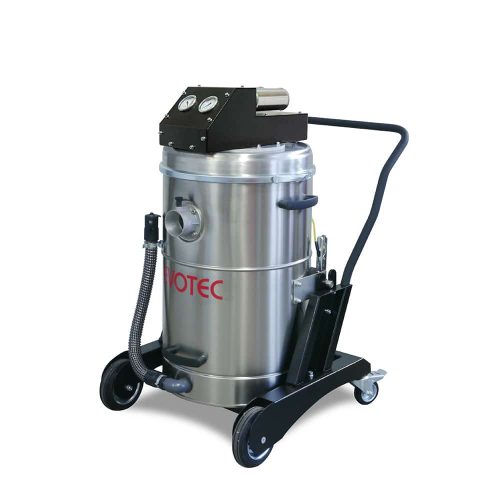
EP 302-120 Compressed air wet vacuum cleaner
Powerful compressed air wet vacuum cleaner for vacuuming liquids.
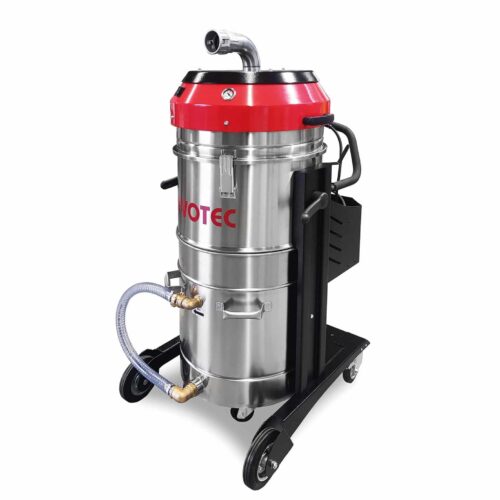
EP 1236-100/ EP 1236-140
Powerful industrial vacuum cleaner with high intake volume for the extraction and separate disposal of liquids/emulsions/oil and solids/swarf.
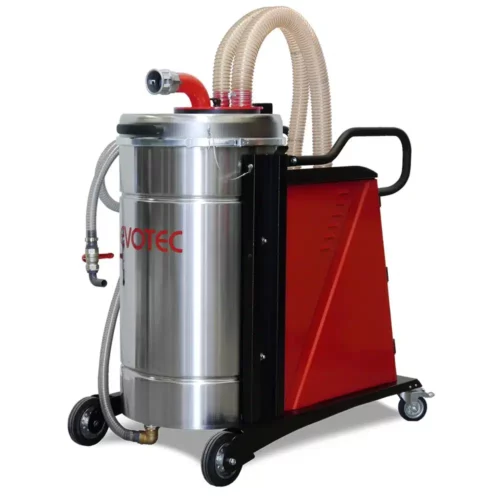
EP 1236 / 2230/ 2240 / 2255
High-performance industrial vacuum cleaner for the extraction and separate disposal of liquids/emulsions/oil and solids/swarf.
Frequently Asked Questions About Emulsion and Oil Extraction (FAQ)
Which vacuum cleaner is suitable for emulsions and oil?
The selection depends on the medium, viscosity, temperature, foaming, solids content, absorption capacity, and discharge method. The safety data sheet and manufacturer’s approval are authoritative.
Can swarf and liquid be separated?
Yes, swarf/emulsion vacuums designed for this purpose can retain coarse solids using a swarf basket or a pre-separator. The achievable separation fineness depends on the swarf shape, particle size, and filter design.
When is it advisable to use a pump or pressure-based drainage system?
If liquid needs to be quickly discharged into a target container that is higher or farther away, pump or pressure drainage may be the best option. The fluid, discharge head, solids content, and equipment approval must be compatible for this purpose.
Can an emulsion vacuum cleaner also extract cooling lubricant mist?
No. An emulsion extractor collects existing liquids and swarf. Airborne cooling lubricant aerosols and vapors require a collection system designed according to fluid dynamics principles and a suitable separator.
Are oily substances automatically flammable or explosive?
No. The risk of fire or explosion depends on the properties of the substance, temperature, aerosol formation, ignition sources, and the process. It is assessed as part of the hazard assessment based on safety data and operating conditions.
Your partner for industrial extraction solutions
EVOTEC develops extraction systems and industrial vacuum cleaners for industrial applications and realizes application-specific special solutions in addition to near-series devices. Our systems are designed for process reliability, durability and individual requirements.
Commissioning
Maintenance
Which extraction solution is best suited for emulsions, oil, and chip generation?
Please provide us with the medium, safety data sheet, temperature, viscosity, chip content, quantity, and desired discharge rate. EVOTEC will assist you in selecting a mobile vacuum cleaner or planning a stationary aerosol collection system.

Robin Buschbaum
Sales D/A/CH
Specialist for extraction technology
vertrieb@evo-products.de
02642 9373-53

Lars Blankenburg
Sales
lars.blankenburg@evo-products.de
02642 9373-10

Asim Zaman-Pahlke
Export Sales
export@evo-products.de
02642/9373-15