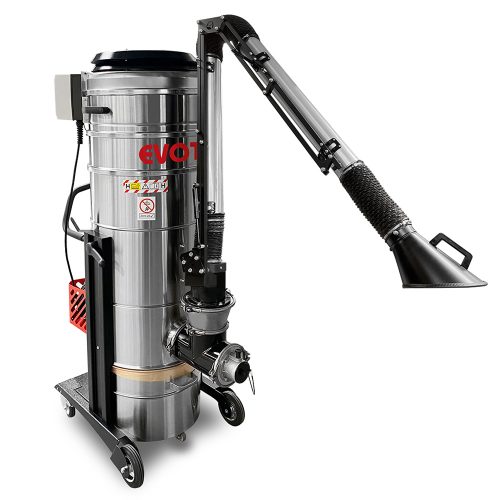
Extracting Fumes, Odors, and Smoke – Capturing Emissions at the Source

Distinguish between particles and the gas phase. Select the appropriate filtration technology. Reduce odor pollution in a controlled manner.

Fume, Steam, and Odor Extraction—Tailored to the Material, Process, and Operating Conditions

Fume, vapors, and odors describe different forms of airborne substances. Fume usually contains very fine particles and may carry gaseous components. Vapors exist in gaseous form; a perceptible odor, however, is neither a substance class nor a reliable indicator of a health hazard.

EVOTEC tailors the collection, airflow capacity, particle filtration, sorption stages, and airflow path to the specific process. The key factors are substance data, the release pathway, and operating conditions—not just visibility or odor.

Your benefits when it comes to fume, steam, and odor extraction:

Measuring Emissions Directly at the Source

Exhaust arms, hoods, enclosures, or machine connections capture substances before they spread throughout the work area.

Properly Treating Particles and the Gas Phase

Particulate filters and sorption stages serve different purposes and are combined based on actual emissions.

Clearly Separate Mobile and Stationary Tasks

Mobile solutions support flexible work and cleaning tasks; stationary systems serve processes that are continuously connected.

Which substances produce fumes, odors, or smoke at your facility—and where do they escape? Please provide us with details regarding the process, substances or safety data, temperature, operating time, and the location where the air is drawn in. We will work with you to review the air intake, filtration design, and airflow.

What are fumes, odors, and smoke?

From a technical standpoint, these terms should not be considered equivalent. When selecting an extraction system, it is necessary to determine whether the substances involved are solid or liquid particles, gaseous substances, or a mixture. Safety data sheets, process data, and the risk assessment form the basis for this determination.

Fume and Aerosols: Fine Particles

Thermal processes such as Welding, Soldering, laser processing, heating, or pyrolysis can generate very fine solid and liquid particles. In addition, gaseous reaction and decomposition products may be produced. Related applications: soldering and welding fume extraction, as well as laser fume extraction.

Vapors, VOCs, and Odors: Gaseous Substances

Solvents, cleaning agents, adhesives, resins, coatings, and heated process materials can release volatile organic compounds or other gaseous substances. An odor may indicate an emission, but it does not reliably indicate either the concentration of the substance or compliance with an occupational exposure limit.

The sense of smell alone is not proof of effectiveness. The DGUV points out that not every hazardous substance is detectable by smell, and conversely, clearly perceptible odors can occur even at very low concentrations. Classification: IFA – Odor and Sense of Smell.

How can fumes and smoke be effectively captured?

Capture determines effectiveness before the filter. Emissions are captured as close as possible to their source or point of discharge. The direction of dispersion, thermal conditions, substance density, process movement, and disruptive cross-flows determine the position and shape of the capture element.

Enclosure, machine connection, and exhaust hood

Enclosed or partially enclosed capture systems limit the spread of contaminants and reduce carryover. Machine connections, edge exhausts, and hoods must be designed to match the release path. Light, warm air streams may require capture above the source; heavy vapors may accumulate near the floor.

Extraction arm and open collection

Movable capture elements are positioned as close as possible and repositioned when the location changes. TRGS 500 emphasizes that simple source extraction is effective only when properly positioned and with an appropriate airflow rate. Room ventilation can reduce residual exposure levels but does not replace source capture. Basis: TRGS 500.

Which filtration technology is best suited for fumes, odors, and smoke?

Particle filtration and gas treatment serve different purposes. The filter configuration depends on the substance phase, concentration, temperature, humidity, flow rate, and operating time. A list of as many filter stages as possible is no substitute for a substance-specific design.

Particle filters for fume and aerosols

Pre-filters, fine filters, and, where applicable, HEPA stages remove solid or liquid particles. The filter area, capacity, and replacement schedule are tailored to the particle size, dust load, and operating conditions. Particle filters do not remove gaseous substances.

Activated carbon and other sorbent media

Activated carbon can adsorb suitable gases and vapors onto its surface. Its effectiveness depends, among other factors, on the chemistry of the substance, concentration, humidity, temperature, contact time, and the amount of carbon. A particle prefilter protects the sorption medium; for non-adsorbable, reactive, or unknown substances, a different treatment or exhaust air discharge may be required.

Tool Life, Breakthrough, and Tool Change Strategy

Sorption media have a limited absorption capacity. Replacement intervals should not be based solely on odor, because odor thresholds vary from person to person and some substances may be odorless. Process data, manufacturer specifications, measurements, or a suitable monitoring plan determine the appropriate time for replacement.

Exhaust Air, Air Recirculation, and Waste Disposal

In the case of hazardous, unknown, or difficult-to-control gas mixtures, exhaust ventilation is often safer than recirculation. Whether purified air may be recirculated depends on the properties of the substances, applicable regulations, and proven effectiveness. Contaminated filters and captured substances must be handled and disposed of in accordance with their properties.

Important: A reduced odor does not indicate compliance with a limit value or complete separation. Effectiveness, filter condition, and airflow must be evaluated separately.

Mobile and stationary extraction systems

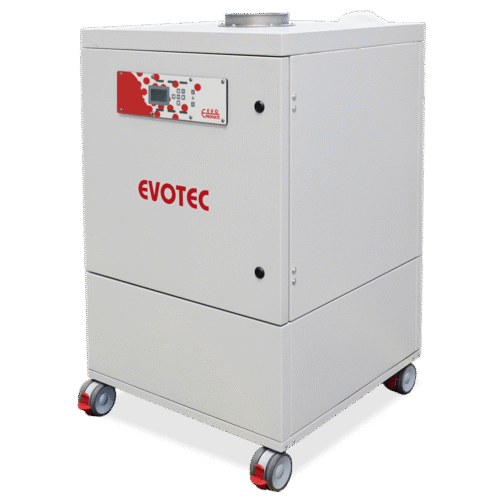
Mobile solutions for flexible and limited tasks

Mobile extraction units are suitable for changing workstations and locally confined emissions, provided that the extraction system and filter configuration are appropriate for the substance. Mobile industrial vacuum cleaners also facilitate the controlled removal of accumulated dry particles; however, they do not replace the necessary extraction of gaseous substances during the ongoing process.

Stationary systems for machines and multiple data collection points

Stationary systems supply permanently connected machines, enclosures, hoods, or multiple workstations. The ductwork, simultaneous-use factor, pressure drop, filter area, sorption stage, monitoring, and exhaust air routing are designed for the actual operating point.

Decentralized or centralized treatment

Decentralized equipment minimizes material flow paths and facilitates process-specific filter selection. Centralized systems can serve multiple similar sources. Different material streams or those that react with one another may only be routed together if this has been evaluated from a safety perspective.

Coordinate Heat Recovery and Room Ventilation

Supply air, airflow patterns within the facility, doors, machine movements, and thermal convection all affect the measurement. General room ventilation serves to supplement unavoidable residual emissions; it should not carry the emissions into the breathing zone or into adjacent areas.

Typical extraction solutions: Machine connection · Enclosure · Perimeter or hood extraction · Articulated extraction arm · Extraction-equipped worktable.

What does the interpretation depend on?

A robust design starts with the actual material and process. Sicherheitsdaten, Freisetzungsrate, Erfassungsgeometrie, Betriebsdauer, Temperatur und gewünschte Luftführung bestimmen die technische Lösung – nicht allein eine sichtbare Rauchfahne oder ein wahrnehmbarer Geruch.

Substances, Mixtures, and Operating Conditions

  • Substances, commercial products, safety data sheets, and potential reaction products
  • Particles, aerosols, gases, or vapors, as well as concentration and odor threshold
  • Temperature, Humidity, Flammability, and Possible Interactions
  • Process Duration, Cycle Time, Shift Work, and Metabolism

Capture, Filter Monitoring, and Airflow

  • Release point, sampling distance, enclosure, and cross-flows
  • Required airflow and negative pressure at the operating point
  • Particulate filter, sorbent, service life, and replacement strategy
  • Exhaust Air or Recirculated Air, Maintenance, and Disposal

Avoid common mistakes: Using activated carbon without testing its performance, insufficient sorption capacity, failing to consider service life, placing the exhaust arm too far away, or evaluating the system based solely on odor can render a seemingly functional system ineffective.

Which data collection and filtering methods are best suited for your emissions?

Please provide us with information on the substances, safety data, process, release point, temperature, operating time, and desired airflow. EVOTEC will assist you in selecting a suitable mobile or stationary solution.

Assess Fire, Explosion, and Substance Risks Separately

Flammable vapors, solvents, and fine particles can pose fire or explosion hazards. In addition, substances may be toxic, irritating, sensitizing, or carcinogenic. Whether separate ductwork, conductive components, zone-specific measures, exhaust ventilation, or other protective measures are required depends on the substance’s properties and a risk assessment. DGUV Rule 109-002 also notes that incompatible or highly flammable substance streams must not be extracted together without due caution.

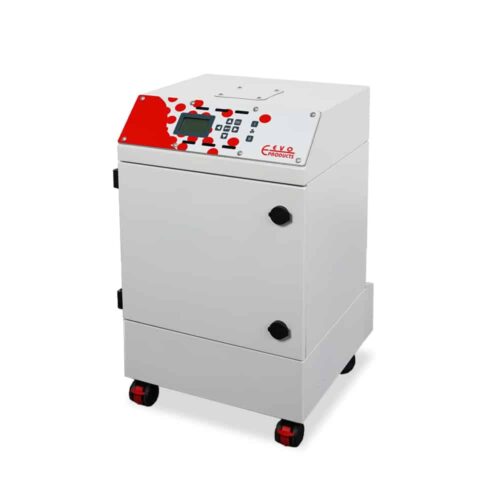
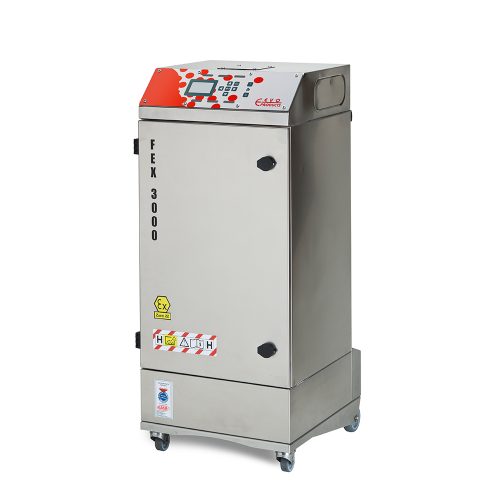
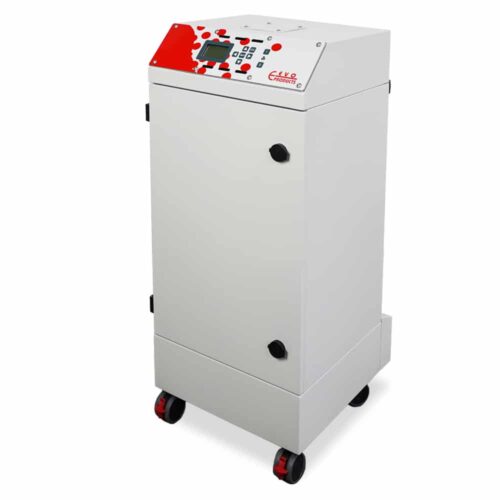
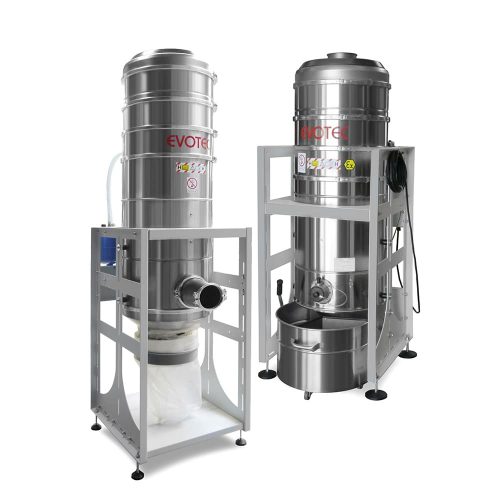
Mobile devices for flexible cleaning and support tasks

Mobile Geräte unterstützen wechselnde Einsatzorte und die Aufnahme abgelagerter trockener Partikel im Umfeld rauch- oder dampferzeugender Prozesse.

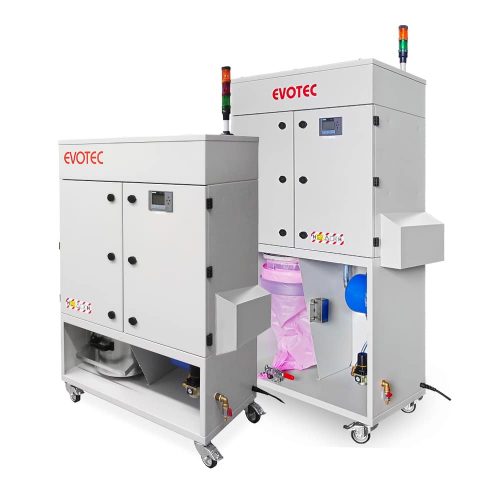
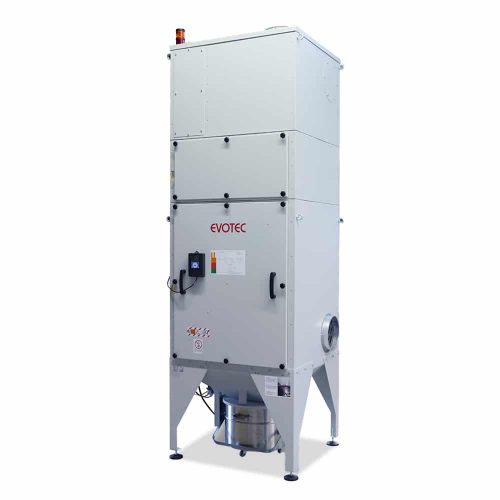
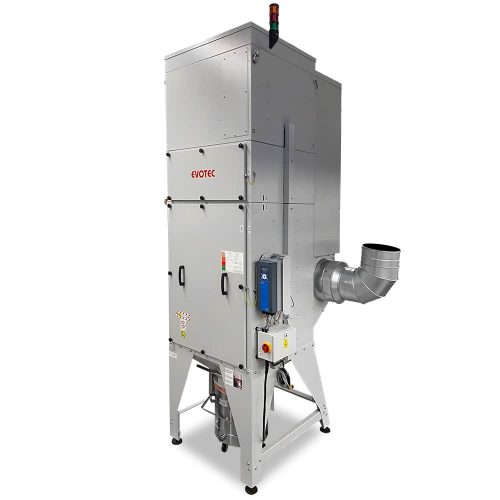
Stationary Extraction Systems for Smoke, Fumes, and Odors

Stationary systems are suitable for permanently connected workstations, machines, enclosures, and multiple sampling points. The series shown, which are categorized by application area, represent a preliminary selection. Filter and sorption configurations are determined only after a substance assessment.

Frequently Asked Questions About the Extraction of Fumes, Vapors, and Odors (FAQ)

What is the difference between fumes, odors, and smoke?

Fume usually contains very fine particles and may carry gaseous components. Vapors are gaseous substances released, for example, from solvents or heated media. Odor describes only human perception and is not a reliable measure of the type, concentration, or hazardousness of an emission.

No. Activated carbon adsorbs only certain substances and has a limited capacity. The effectiveness depends on the chemical properties of the substance, its concentration, humidity, temperature, contact time, and the amount of carbon used. For some substances, impregnated sorbents, other methods, or exhaust ventilation are required.

As close as possible to the point of generation or discharge. Depending on the process, options may include machine connections, enclosures, hoods, edge extraction, tables, or extraction arms. The position, distance, and airflow rate must be appropriate for the direction of dispersion and any possible cross-flows.

Mobile solutions are suitable for variable, locally confined tasks and for cleaning. Stationary systems are designed for permanently connected machines, multiple collection points, and continuous operation. For gases and vapors, the collection, sorption stage, and exhaust air routing must be examined with particular care.

Only if the properties of the substance, the risk assessment, and applicable requirements permit it, and the required effectiveness is demonstrated. For unknown, particularly hazardous, or poorly adsorbable substances, exhaust ventilation may be required.

EVO-PRODUCTS

Ihr Partner für industrielle Absauglösungen

EVOTEC develops mobile and stationary extraction solutions for industrial processes and produces not only devices close to series production but also application-specific custom solutions. Collection, airflow, particle filtration, sorption stages, monitoring, and airflow management are tailored to the actual material flow.

When it comes to fumes, odors, and smoke, we combine an understanding of the process with a clear distinction between particle separation and gas treatment.

Years of experience
1 +
Developed models
1 +
Satisfied customers
1 +
MADE IN GERMANY
1 %
1
Analysis of the Situation
Abstimmungsgespräch zur Ermittlung kundenspezifischer Anforderungen
2
Concept Development
Gemeinsame Entwicklung von Lösungsansätzen sowie Ausarbeitung eines Absaugkonzepts unter Berücksichtigung der bestehenden Infrastruktur
3
Quotation Preparation
Detaillierte Angebotserstellung auf Basis der spezifischen Kundenanforderungen
4
Placing an Order
Abschließende Projektplanung und vertragliche Fixierung
5
Production
Maßgeschneiderte Fertigung der Anlagen und Komponenten
6
Delivery, Installation, &
Commissioning
Sichere Auslieferung der Anlage, Montage durch EVO-PRODUCTS-Techniker oder detaillierte Aufbauanleitung für kundenseitige Ausführung
7
Training, After-Sales &
Maintenance
Anlagen-spezifische Schulung, optionale Wartungsverträge & Services

Which fume, steam, or odor extraction system is right for your process?

Please provide us with information on substances and safety data, the process, the release point, temperature, operating duration, the number of workstations, and the planned airflow pattern. EVOTEC will assist you in selecting the appropriate collection method, filter technology, and system design.

Robin-graust..jpg

Robin Buschbaum
Sales D/A/CH
Specialist for extraction technology
vertrieb@evo-products.de
02642 9373-53

asim-03.jpg

Asim Zaman-Pahlke
Export Sales
export@evo-products.de
02642/9373-15

Scroll to Top